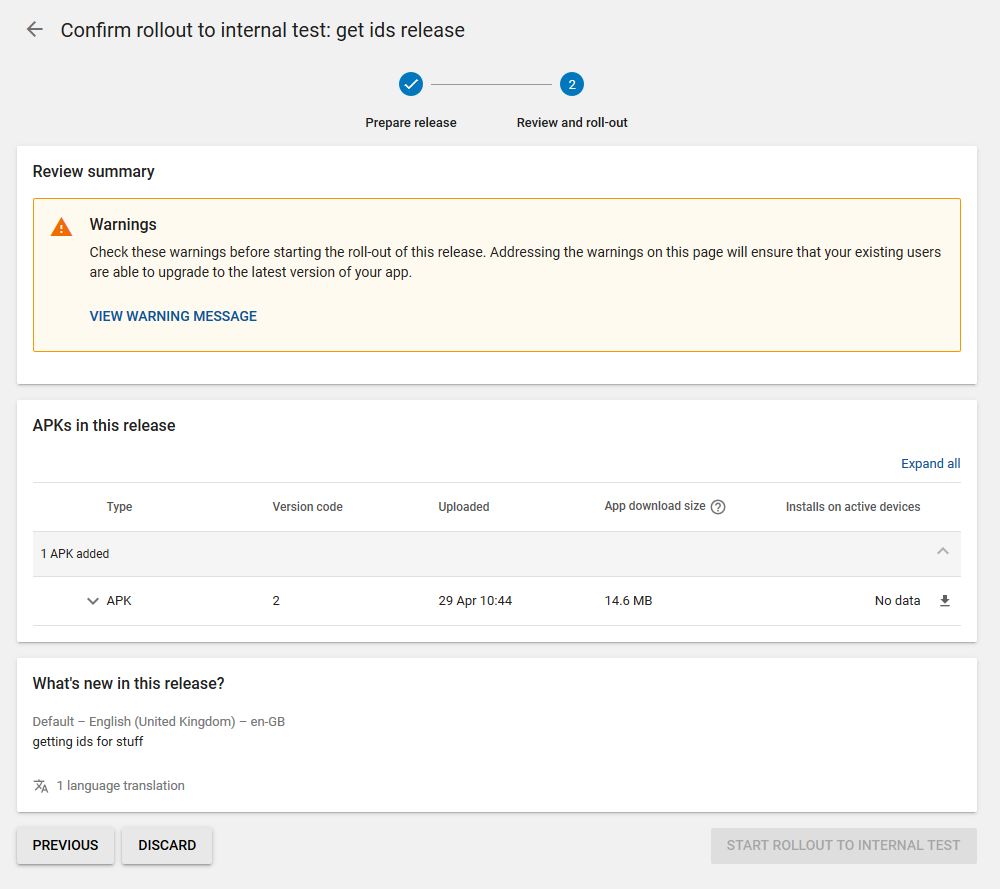
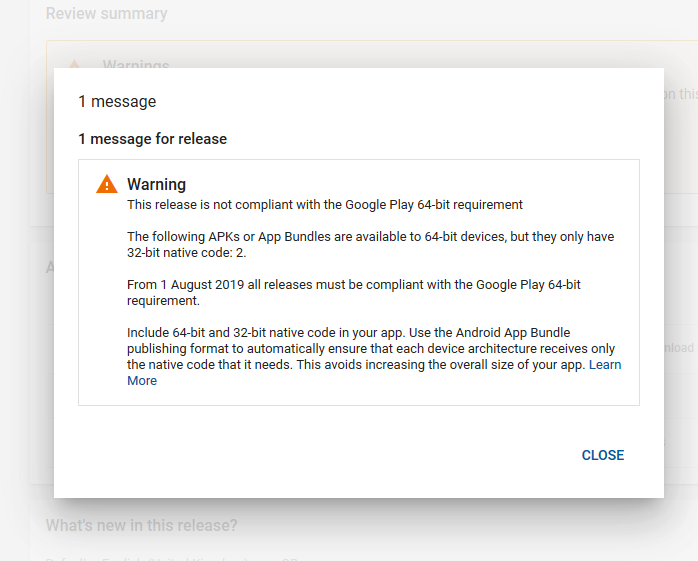
For the record I created a new Play Store entry a couple of weeks ago with an internal beta APK, gradually updated and pushed to alpha, then production about a week ago, and I didn’t see this warning even once.
Is it possible that the devices you’ve selected for internal testing are literally 64bit only? Android is built from the Linux kernel and it is possible to compile a kernel without support for 32bit binaries, so it’s theoretically possible that some Android devices have that kind of a kernel.
I released an update to a previous game a few months back without any warning or problem…
This is the first time I’ve ever seen this.
I don’t see any way I could have selected devices at all - I don’t see any UI for that and the actual device I test on is the same for over a year and never had a problem testing previously (and runs the game using direct upload to the device from pc just fine).
I just uploaded a new APK built using latest corona daily build and same issue…
I’m adding myself to this thread to be updated regarding the 64-bit change. I can’t imagine Google will keep to a date just a few months away from when their warning first appeared. What is the earilest date anyone has seen this warning?
OK - finally figured this out and it is stupid. I emailed google developer support twice with no response at all BTW.
Anyways the store listing was greyed because I had not uploaded images (which I didn’t want to do because the game was not finished!) - and so I thought maybe I put some placeholders in there…and sure enough the rollout button is now enabled.
No warning or info on the page to say this was why it was disabled!
This may have happened to me before last year…maybe I forgot…anyways if this happens to anyone else, FYI.
We are working on it as fast as we can. Yes, iOS is already 64bit, but Android isn’t iOS. The build system is radically different and has many moving parts.
They won’t run faster on 32bit platforms since it will still be 32bit code that is executed there. Both, 32bit and 64bit code will be packaged in one bundle afaik. So if it would be faster it would only affect the 64bit devices then.
64bit generally means the ability to address more memory. It lets you have more precise integers, though Lua won’t gain more precision. There is a year 2038 problem with os.time() being 32 bit when the number of seconds since Jan 1, 1970, the value that most Unix/Linux based systems uses for a clock overflows. Getting time functions on 64 bit helps resolve that.
There are two many instances with today’s hardware where 32 bit has become too small to work on.
@umalemon, thank you for the kind words. We believe Corona is a great product and we glad you like it.
On the subject on a little funding, we provide multiple ways to help with funding. We created two tiers of annual support that you can purchase in the marketplace. Purchase some assets from our marketplace. In particular for Audio, there are some great bundles.
I’m not sure how many are aware of the progress, perhaps it has been discussed on Slack, perhaps not, but based on what @vlads said on another thread, this is a couple of months away:
“I’m now working on rewriting build system to gradle & latest NDK. Should be ready in couple month.” (Vlads, 7 May)
We are still working on it. Vlad posted this in the community Slack a few days ago:
hey @here. Just in case someone is interested, I put out some mid-road results of new android build system. At this stage you can build and run everything very easily, much simpler than before. Using newest tools (Android Studio or IDEA) and in Android Simulator (AVD). I’m working on plugging it into Corona Simulator for offline builds right now. It is complicated process and there lot of nuances and challenges, with supporting of existing plugins and build.settings entries.
This is useful if you want to get started and help with something Android related, because process is way, way more streamlined.