
yep. I did see it. I will have an update as soon as I update the next app.
Hi, is there any update on this? Did the IronSource plugin update reduce the ANRs?
Also, was the IronSource adapter within the Appodeal plugin also updated?
We’ve had only a single report of an ANR on the latest version of Scott’s ironSrc plugin which has had the effect of driving down our overall ANR quite substantially.
I won’t know about the Appodeal plugin as we haven’t used that for any of our recent apps, sorry.
1 Like
@agramonte Would it be possible for you to add the setUser function to the Bugsnag init() function please? It would make it easier for us to pair things up with other analytics we use, to pin down crashes and ANRs.
Or if the source repo is public I don’t mind doing this myself via a pull request, to save you having to do it.
This is the function:
//Java
Configuration config = Configuration.load(this);
config.setUser(id, email, name); <--this line
Bugsnag.start(this, config);
//ObjC
BugsnagConfiguration *config = [BugsnagConfiguration loadConfig];
[config setUser:id withEmail:email andName:name]; <--this line
[Bugsnag startWithConfiguration:config];
Sure, of course. I’ll see what is easier for me to do.
@alanFlickGames, the ios version is updated, I also included the source code for any future changes. Working on the Android version.
1 Like
Thank you. Once the Android one is there I will test them both out, and let you know if all is ok.
When I build using the simulator, everything works fine, but when I build using the native method, I always get the error “ld: framework not found Bugsnag”.
What is the full error? and what is your min SDK for iOS.
xcode 14.2
The full error:
[10:20:29]: ▸ Compiling AppCoronaDelegate.mm
[10:20:29]: ▸ Linking App1
[10:20:29]: ▸ ❌  ld: framework not found Bugsnag
[10:20:29]: ▸ ❌  clang: error: linker command failed with exit code 1 (use -v to see invocation)
[10:20:29]: ▸ ** ARCHIVE FAILED **
[10:20:29]: ▸ The following build commands failed:
[10:20:29]: ▸ 	Ld /Users/xxx/App1-cskcnfzykvlcjtdmmyawqabnduao/Build/Intermediates.noindex/ArchiveIntermediates/App1/InstallationBuildProductsLocation/Applications/App1.app/App1 normal (in target 'App1' from project 'App1')
[10:20:29]: ▸ (1 failure)
I don’t usually build natively. But the steps are usually to copy the library and the framework to your project, then include all the libraries and other items required by the library. Those are listed in the lua file that is part of the package. Other than that, I don’t know what else you need to do. Maybe others can help.
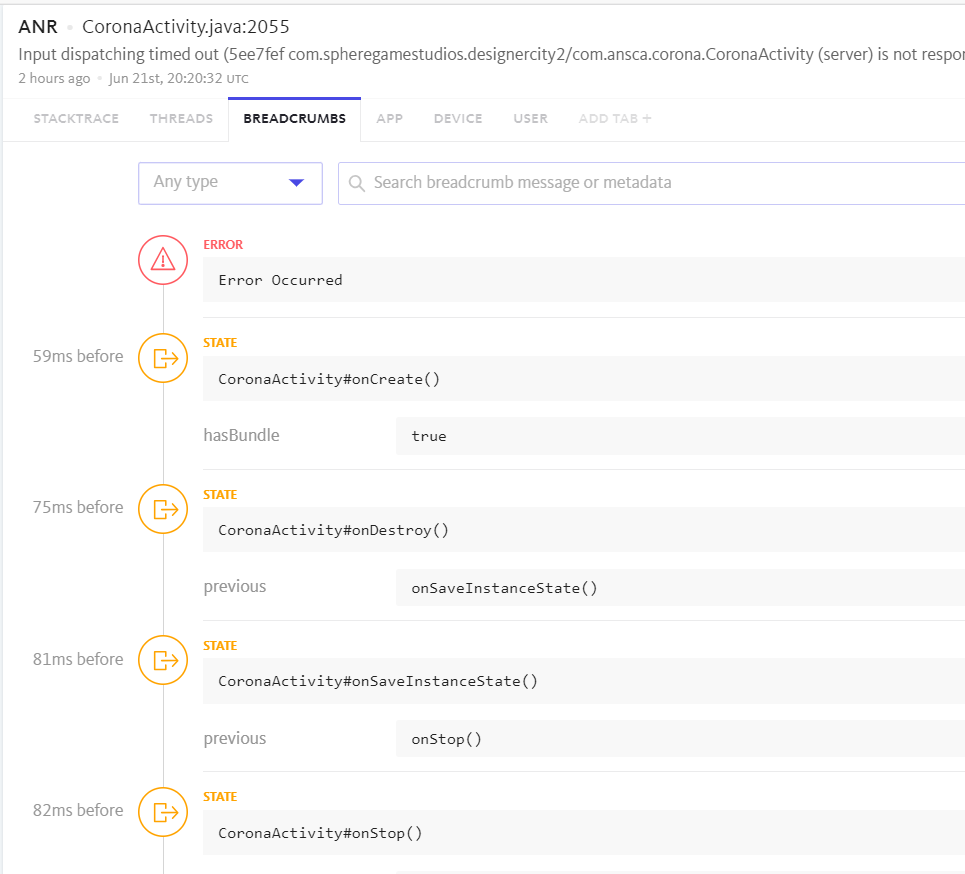
I’m removing bugsnag now as it hasn’t yielded any single point of failure apart from around suspend/resume and unity ads plugin (neither of which devs have any control over). ANRs just seem to happen randomly in hundreds of different libraries. Every day I get 20-30 new errors daily per game.
This is a typical trace…
Just a sample of new today for one game…
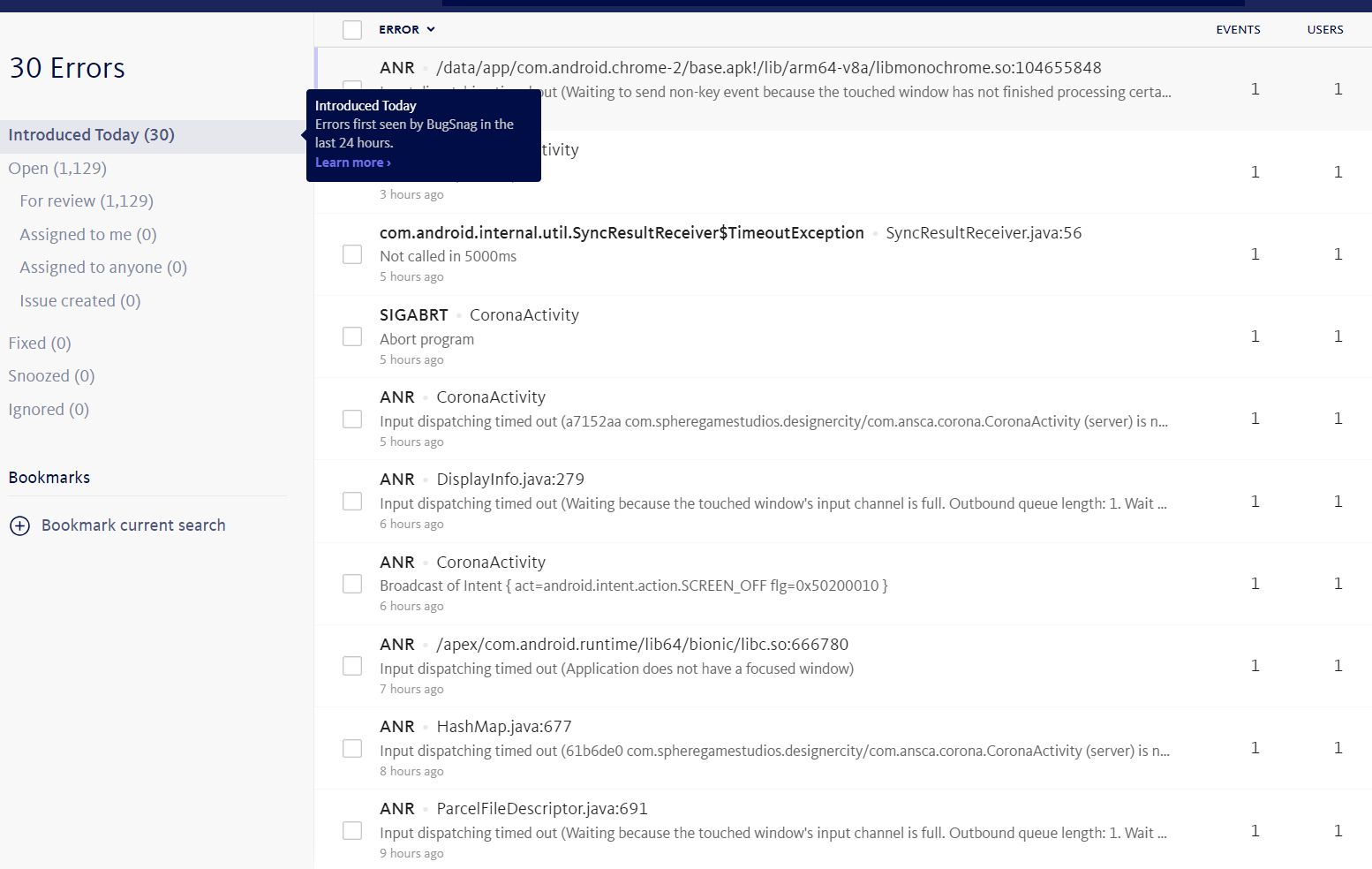
This will not be fixed unless the user input is decoupled from the main thread.
1 Like
Something I’m trying out in my next build is to override my print statements in release builds so that every print call gets logged as a breadcrumb (I already do something similar so send the print logs to our database when there is a lua error).
I’m hoping it might point to a few common points of failure.
The source and the new plugin are up.
1 Like
Hi.
May I ask you send me a PM with your App’s actual size, and obb file size if you have?
Because I suspect the ANR which top stack was android.os.MessageQueue.nativePollOnce may related to Resources size and slow storage such as UFS 2.1 and below.
Google Play has some new embedded insights in their ANR traces, I opened an issue in GitHub regarding com.ansca.corona.Controller
1 Like
I have not been monitoring Google Play closely, but it looks like ANR rate has been over over the threshold for almost a year now. No ads, or crazy plug-ins. Would really like this to get addressed, it’s causing our app to drop in rankings quite a bit.
1 Like
I know I’m behind and a lot of you have been digging into this for a year. But I noticed a correlation between memory size on the device and ANR rate. Devices with 1.5-2GB of RAM had nearly twice the ANR rate of other devices.
Anyone also see the same trend?
yep, afaik, devices with less than 4GB RAM experienced application not responding (ANR) issues more than twice as often as those with 4GB or more.
This topic was automatically closed 180 days after the last reply. New replies are no longer allowed.